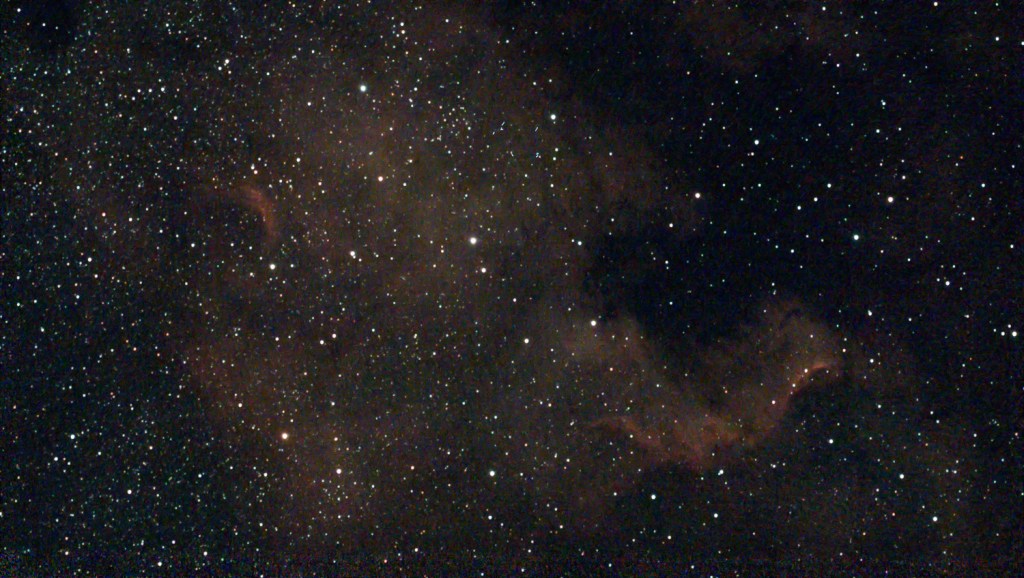
NGC 7000 is more commonly called the the North America Nebula. It gets its nickname from its coincidental resemblance to our continent—if you squint and pretend a little, you can see Mexico and Central America to the right, and the Gulf of Mexico and Florida center-right. The nebula is a glowing cloud of hydrogen gas a couple hundred light years across and between 2,000 and 3,000 light years away. I’m still learning how to use the Dwarf, so I recognize the limits of this photo. Despite its flaws, however, I’m delighted to have this photograph. It doesn’t look like much, but I first learned about NGC 7000 when I took my first college astronomy class in 1988, and it always was a favorite.
Note the pinkish color. NGC 7000 glows pink because that’s what molecular hydrogen does when it’s hit by the radiation from nearby stars. It has enough gas to probably form millions of new stars with giant clouds of dust, visible as dark clumps and tendrils. Stars are currently forming in “Central America” and “Canada.” The fun of a nebula like this is when giant stars inside of it or just outside periodically collapse and explode. The shock waves from these explosions, called Type II supernovae, travel through all that gas and cause a bunch of eddies and disturbances. Given enough time, the eddies collapse and eventually form stars, sometimes accompanied by planets. Wait a few billion years in a place like this, and who knows what might happen on one of the planets that will form?
 Photos Etc.
Leave a comment